

One Llodio Drive, Hermitage, PA USA 16148

10 Tips for Choosing Pharmaceutical Containers
Choosing pharmaceutical containers is not a matter of selecting the most attractive bottle on a supplier’s catalogue. The container protects product quality from filling through patient use. It must control moisture, oxygen, light, contamination, and physical damage. Small decisions matter.
As packaging expert Walter Soroka explains, “Packaging is the science, art, and technology of enclosing and protecting products for distribution, storage, sale, and use.” This principle is especially important for pharmaceutical containers. A clear vial may support visual inspection, yet it can expose light-sensitive medicine to harmful radiation. A tight closure may reduce leakage, but it can also make opening difficult for older patients.
This guide presents ten practical tips for choosing pharmaceutical containers with greater confidence. It considers material compatibility, container-closure integrity, sterilization, dosing accuracy, storage conditions, labeling space, and user safety. It also examines testing evidence, supplier qualifications, and manufacturing consistency. Experienced teams should review stability data, extractables and leachables, and real handling conditions before approving a design.
No container is perfect.
A laboratory result may not reflect a humid warehouse, a hurried caregiver, or repeated opening at home. That gap deserves attention. The best decision combines documented test results with practical observation. It also includes careful consultation with qualified packaging, quality, and regulatory professionals. Requirements can vary by product, market, and dosage form.
These ten tips are not a substitute for formal evaluation. They are a disciplined starting point. Good pharmaceutical containers should protect the medicine, support the patient, and provide reliable performance throughout the product’s intended life.
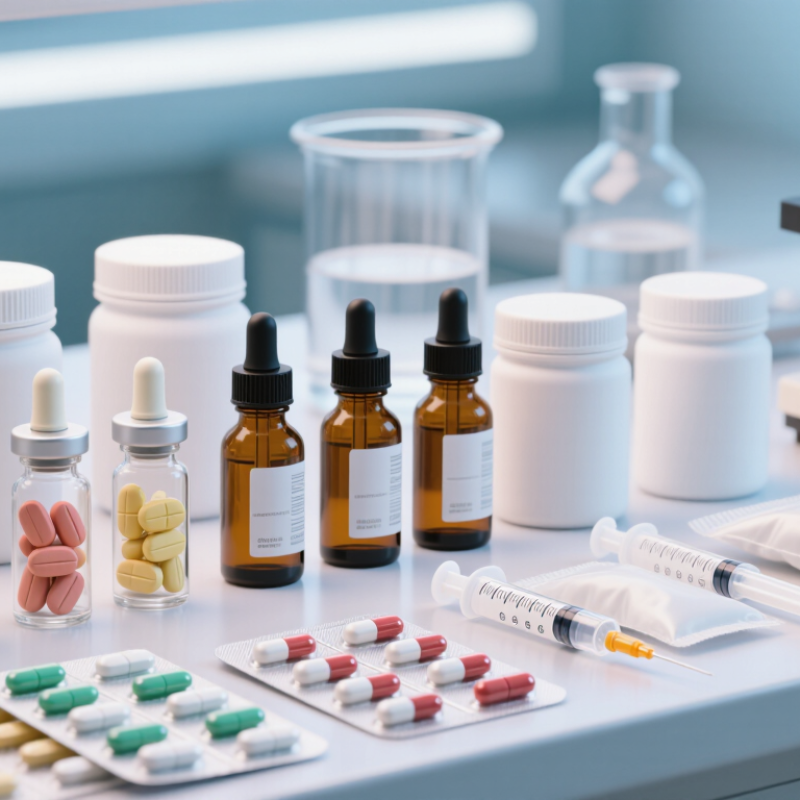
Pharmaceutical Container Types and Their Intended Uses
10 Tips for Choosing Pharmaceutical Containers
Pharmaceutical container selection begins with the product’s intended use. Tablets often need bottles that limit moisture, light, and accidental opening. High-density polyethylene can provide practical moisture protection for solid doses. Amber glass helps shield light-sensitive formulations. Use the smallest suitable headspace. Too much air can increase oxidation risk.
Liquid medicines require different control points. A bottle should support accurate dosing, clean pouring, and chemical compatibility. Oral syrups may use bottles with calibrated oral syringes or dosing cups. Eye drops need sterile, low-particle container-closure systems. Injectable products commonly require glass vials, ampoules, or polymer systems designed for sterility and extractables control. The FDA Container Closure Systems guidance stresses protection, compatibility, and microbiological safety. USP General Chapter <661.1> also evaluates plastic materials through physicochemical and biological tests.
Stability evidence should guide the final choice, not appearance. ICH Q1A(R2) defines accelerated testing at 40°C ±2°C and 75% ±5% relative humidity for six months. These conditions can expose weak seals, label failure, or moisture entry. USP <671> provides permeability testing principles for packaging materials. A child-resistant closure may protect households, but it can frustrate elderly patients. That trade-off needs user testing. I once favored a compact bottle, then noticed its narrow neck slowed filling and trapped powder. Container decisions deserve that kind of practical doubt. Record torque, drop resistance, dosing accuracy, and closure integrity before approval.
10 Tips for Choosing Pharmaceutical Containers - Pharmaceutical Container Types and Their Intended Uses
| No. | Container Type | Common Pharmaceutical Form | Intended Uses | Key Selection Considerations | Typical Protection Provided |
|---|---|---|---|---|---|
| 1 | Amber Glass Bottle | Tablets, capsules, oral liquids, and light-sensitive solutions | Packaging medicines that may degrade when exposed to ultraviolet or visible light | Check hydrolytic resistance, glass type, closure compatibility, breakage risk, and required light transmission limits | Excellent chemical stability and protection from light |
| 2 | Clear Glass Bottle | Parenteral solutions, ophthalmic products, and non-light-sensitive liquids | Providing a chemically stable container where visual inspection of the contents is important | Confirm light sensitivity, extractables, surface quality, dimensional tolerance, and compatibility with the closure system | High transparency, strong barrier performance, and low permeability |
| 3 | High-Density Polyethylene Bottle | Tablets, capsules, powders, and selected oral liquids | Offering lightweight, impact-resistant packaging for solid and liquid medicines | Evaluate moisture and oxygen permeability, chemical compatibility, stress cracking, and closure fit | Good impact resistance and useful moisture protection when properly closed |
| 4 | Polypropylene Bottle | Tablets, capsules, powders, and some liquid formulations | Supporting products that require good chemical resistance and higher temperature tolerance than many common plastics | Assess product compatibility, oxygen transmission, sealing performance, brittleness at low temperatures, and sterilization requirements | Chemical resistance, low density, and moderate moisture barrier properties |
| 5 | Blister Pack | Unit-dose tablets and capsules | Separating individual doses to improve portability, dose tracking, and product protection | Select the forming film and lidding material according to moisture, oxygen, light, and child-resistance requirements | Unit-dose protection, tamper evidence, and controlled access to each dose |
| 6 | Strip Pack | Tablets and capsules | Providing individually sealed doses using flexible layers around the medicine | Review seal integrity, material compatibility, moisture barrier, machine performance, and ease of opening | Strong separation from humidity, air, and contamination when properly sealed |
| 7 | Sterile Vial | Injectable powders, solutions, and suspensions | Containing sterile medicines intended for injection, including products requiring reconstitution | Confirm container-closure integrity, sterilization method, stopper compatibility, extractables, and resistance to handling conditions | Sterility maintenance, low permeability, and compatibility with aseptic processing |
| 8 | Pre-Filled Syringe | Ready-to-use injectable solutions and suspensions | Delivering a measured dose while reducing preparation steps and medication-transfer requirements | Assess drug-contact materials, silicone or lubricant requirements, break-loose force, dose accuracy, and device compatibility | Dose accuracy, sterility, convenience, and reduced handling exposure |
| 9 | Aluminum Tube | Topical creams, ointments, gels, and pastes | Packaging semisolid products that benefit from a collapsible, low-permeability container | Check internal coating compatibility, pinhole control, crimp quality, product viscosity, and dispensing performance | Very strong barrier against light, oxygen, moisture, and external contamination |
| 10 | Metered-Dose or Pump Container | Nasal sprays, topical products, and selected oral liquids | Delivering a controlled volume or spray pattern with each actuation | Test delivered volume, spray pattern, priming, orientation, clogging, microbial protection, and compatibility with the formulation | Controlled dosing, reduced contamination risk, and convenient administration |
Related Posts
-
What Are Pharmaceutical Containers Used For?
-
Why are Pharmaceutical Containers Essential for Medicine Safety?
-
Top 10 Pharmaceutical Containers You Need to Know About?
-
What is the Best Type of Pharmaceutical Containers for Export?
-
How to Choose Pharmaceutical Packaging for Global Sourcing
-
Best Beverage Bottles for Quality and Eco-Friendly Options?