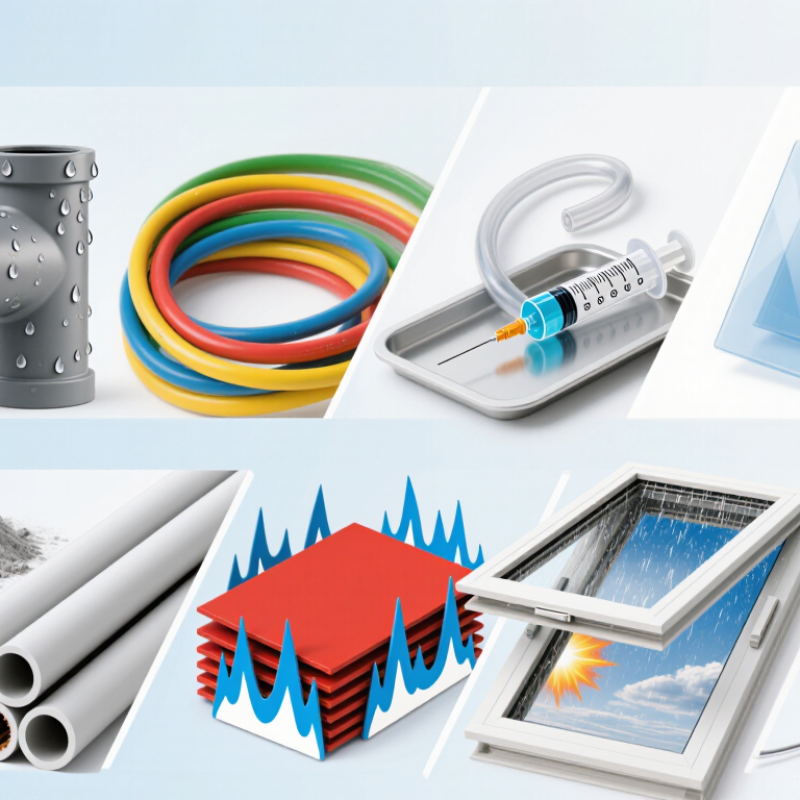
Choosing the right Upvc Compounds begins with understanding how formulation affects performance. These materials are not interchangeable pellets. Each grade balances PVC resin, plasticizers, stabilizers, lubricants, fillers, pigments, and processing aids. A rigid window profile needs stiffness and weather resistance. A flexible cable coating needs softness, insulation, and controlled migration. Different applications demand different compromises.
George Wypych, a respected PVC formulation specialist and author, offers a useful principle: “A formulation must be judged by its application, not by isolated ingredients.” That idea guides this overview. The following ten types of Upvc Compounds are grouped by practical use, performance targets, and processing behavior. They include rigid profile compounds, pipe compounds, flexible grades, cable compounds, medical-oriented formulations, transparent compounds, impact-modified grades, filled compounds, flame-retardant compounds, and weather-resistant formulations.
The categories may overlap. They are not universal industry boxes. Some manufacturers use different names for similar recipes. This can confuse buyers.
Real performance depends on more than a product label. Processing temperature, screw design, cooling rate, storage conditions, and outdoor exposure can change the final result. A compound that performs well in a laboratory may behave differently on a busy extrusion line. That uncomfortable detail matters. This guide therefore examines what each type is designed to do, where it works best, and which weaknesses engineers should question before selecting it.
UPVC compounds are engineered PVC formulations without intentionally added plasticizers. Their role is practical: they balance stiffness, weather resistance, flame performance, surface finish, and processing stability. A compound usually contains PVC resin, heat stabilizers, lubricants, impact modifiers, pigments, and sometimes mineral fillers. The exact recipe changes with the product.
Commercial categories commonly include rigid pipe, drainage pipe, window profile, door profile, electrical conduit, roofing sheet, wall cladding, foam board, injection-moulded fittings, and cable protection systems. These are the top ten application types, rather than ten universal chemical grades. Pipe compounds need reliable pressure performance and smooth internal surfaces. Window compounds require colour stability under sunlight. Foam boards need controlled cell structure and low density. The boundaries are not perfectly clean. One formulation may serve several applications after processing adjustments. VinylPlus reported 810,775 tonnes of PVC recycled in Europe in 2022, showing why compound design increasingly considers recyclability and consistent material identification.
Tips: Check the technical data sheet before selection. Compare Vicat softening temperature, impact strength, density, colour retention, and processing temperature. A compound that looks suitable may fail after repeated heating or outdoor exposure. Keep moisture and contamination low during production. Small errors matter. In practice, trial extrusion remains valuable, because laboratory data cannot reproduce every die, cooling system, or wall thickness. Industry reports provide direction, but factory evidence should guide the final decision.
UPVC compounds are best classified by formulation, processing method, and end use. The main criteria include resin grade, plasticizer absence, stabilizer system, impact strength, weather resistance, color, density, and thermal behavior. In practical production work, these factors often matter more than the product label. Small formulation changes can affect surface finish, weld strength, and dimensional stability.
The ten common types include general-purpose rigid UPVC, pipe-grade compound, profile-grade compound, injection-molding grade, impact-modified compound, weatherable compound, foamed compound, drainage-grade compound, cable-conduit compound, and fire-performance compound. Pipe grades usually prioritize pressure resistance and long-term stiffness. Profile grades focus on smooth extrusion, dimensional accuracy, and reliable corner welding. Impact-modified grades contain additives that reduce cracking during handling. Weatherable grades resist ultraviolet exposure and color fading. Foamed grades reduce weight, but their cell structure needs careful control.
Classification should also consider testing evidence. Engineers commonly review tensile strength, impact resistance, Vicat softening temperature, density, melt flow behavior, and color stability. Processing temperature matters too. A compound that performs well in injection molding may behave poorly during profile extrusion. This is an easy mistake. Laboratory data can also differ from factory results because moisture, equipment wear, and cooling conditions change outcomes. A reliable assessment therefore combines technical data with production trials, inspection records, and the intended service environment. One test is rarely enough.
UPVC compounds are commonly classified by their end use, required mechanical performance, processing method, weather resistance, and regulatory requirements. The chart compares the relative formulation emphasis typically associated with ten major UPVC compound types. The index ranges from 1 to 5 and is a qualitative comparison rather than a standardized material rating.
Key criteria: impact modification, weathering resistance, flame retardancy, dimensional stability, electrical insulation, chemical resistance, pressure performance, and surface appearance.
What Are the Top 10 Types of UPVC Compounds?
The Top 10 UPVC Compound Types by Composition
UPVC compounds differ mainly through their resin, additives, fillers, and stabilizers. The ten common composition types include pure resin compounds, calcium carbonate-filled compounds, impact-modified compounds, heat-stabilized compounds, UV-stabilized compounds, tin-stabilized compounds, calcium-zinc-stabilized compounds, processing-aid compounds, flame-retardant compounds, and color-modified compounds. These categories can overlap. A window profile may use calcium carbonate, impact modifiers, UV protection, and color pigment together.
Pure resin compounds offer a clean base for controlled formulation. Filled compounds reduce material cost and can improve stiffness, but excessive filler may create brittleness. Impact-modified grades use acrylic or chlorinated modifiers for better resistance to knocks and cold weather. Heat stabilizers protect the compound during processing. UV stabilizers help reduce fading and surface damage outdoors. Calcium-zinc systems are widely considered a more responsible modern choice, while tin-based systems can support demanding processing conditions. Flame-retardant and color-modified grades need careful testing because additives can affect strength, fusion, and appearance. This classification is useful, though not perfectly clean.
Tips: Check the compound’s filler level, stabilizer system, impact strength, and processing temperature before selection. Ask for test data, not only a technical label. A bright sample may still perform poorly outdoors. In practice, the best formula depends on wall thickness, equipment, climate, and expected service life. Small formulation changes can produce surprisingly different results.
UPVC compounds are tailored for different service conditions.
Window-profile compounds balance rigidity, weather resistance, and low thermal movement. Door-profile compounds add impact strength for repeated opening and closing. Pressure-pipe compounds resist internal pressure and chemical exposure. Drainage-pipe compounds prioritize smooth flow and dimensional stability. Electrical-conduit compounds provide insulation and flame performance. Cable-trunking compounds need clean extrusion and dependable impact resistance. Siding compounds improve color retention and outdoor durability. Foam-profile compounds reduce weight and improve insulation. Injection-moulded fitting compounds support accurate threads, sockets, and complex shapes. Rigid-sheet compounds serve partitions, cladding, and protective covers.
Applications change the formulation. Calcium carbonate can improve stiffness and reduce cost, but excessive loading may weaken impact performance. Stabilizers protect the compound during processing and outdoor exposure. Impact modifiers help in cold climates, while processing aids improve surface finish.
The boundary is not perfectly clean. A window compound may resemble a siding compound, yet their weathering targets differ. VinylPlus reported 810,775 tonnes of PVC recycled in Europe during 2023, showing why recycled content and contamination control deserve attention (VinylPlus 2024 Progress Report). Material selection should also consider local temperature, UV exposure, pressure class, and installation stress.
Tips: Ask for a technical data sheet, impact results, Vicat softening temperature, and long-term weathering evidence. Check whether recycled content matches the application. A low-cost formula can become expensive after warping, cracking, or color change. Independent laboratory testing remains valuable, especially when supplier claims seem unusually optimistic.
Selecting the right UPVC compound starts with the processing method, not the product label. The top ten useful categories include rigid, impact-modified, weatherable, foamed, filled, transparent, low-gloss, high-gloss, flame-retardant, and recycled-content compounds.
For profile extrusion, choose a rigid compound with stable melt strength and controlled fusion time. Window profiles need weatherability and impact resistance, especially after repeated heat exposure. Injection molding usually benefits from better flow and faster fusion. A filled grade may reduce shrinkage, but excessive filler can weaken weld lines. Check the formulation sheet carefully.
Small details matter.
For outdoor use, compare accelerated weathering results, not only titanium dioxide content. For piping, verify hydrostatic pressure data, Vicat softening temperature, and long-term performance under the relevant standard. ISO 1163 provides a useful framework for PVC-U material designation, while ASTM D1784 classifies rigid PVC compounds by strength, modulus, and impact properties. These standards improve comparison, though they do not replace plant trials.
Sustainability can also influence selection. The VinylPlus 2024 Progress Report recorded 810,775 tonnes of PVC recycled in Europe during 2023. Recycled-content compounds may lower material impact, but batch consistency requires closer moisture, color, and contamination control. That part is often underestimated. Trial the compound on the actual screw, die, cooling system, and cycle time. A grade that performs well in a laboratory may still produce rough surfaces, die buildup, or unstable dimensions in production. Data helps, but processing experience remains decisive.
| No. | UPVC Compound Type | Typical Products | Key Formulation Characteristics | Typical Performance Profile | Recommended Processing | How to Select |
|---|---|---|---|---|---|---|
| 1 | General-Purpose Rigid Extrusion Compound | Profiles, trims, channels, rigid tubes and construction sections | Balanced PVC resin, thermal stabilizer, lubricant system, processing aid and a moderate level of mineral filler. | Good dimensional stability, surface finish and stiffness; suitable for routine indoor and general construction applications. | Single- or twin-screw extrusion. Common melt-processing range is approximately 170–205°C, depending on formulation and equipment. | Choose this grade when balanced cost, stiffness, appearance and general processability are more important than extreme impact or weathering performance. |
| 2 | Pressure-Pipe UPVC Compound | Potable-water pipes, irrigation pipes and industrial fluid-pressure pipes | High-molecular-weight PVC resin with controlled filler content, stabilizers suitable for the intended service, and formulation control for long-term pressure performance. | High hoop strength, chemical resistance, low water absorption and strong resistance to corrosion; normally designed around recognized pipe standards. | Dedicated pipe extrusion with careful control of melt temperature, vacuum sizing, cooling and wall-thickness uniformity. | Select according to pressure class, service temperature, fluid compatibility, regulatory requirements and the applicable pipe standard. Do not substitute a general profile compound. |
| 3 | Drainage and Sewer Pipe Compound | Non-pressure drainage, sewer, soil and waste pipes | Rigid PVC base with stabilizers, lubricants and impact modifiers or mineral reinforcement selected for underground and building-drainage conditions. | Good ring stiffness, chemical resistance, low friction and resistance to moisture; impact performance is important during handling and installation. | High-output pipe extrusion followed by vacuum calibration, water cooling and socket or end-forming operations. | Prioritize ring stiffness, low-temperature impact, wall-thickness control, installation temperature and compliance with the relevant drainage standard. |
| 4 | Weatherable Window and Door Profile Compound | Window frames, door profiles, façade sections and exterior architectural profiles | UV-resistant stabilizer package, impact modifier, titanium dioxide or other light-scattering pigment, processing aid and controlled lubricant balance. | Improved color retention, weathering resistance, surface quality, weldability and dimensional stability for long-term outdoor exposure. | Profile extrusion, often with co-extrusion or lamination for decorative or protective surfaces; precise fusion and cooling control are required. | Select based on climate, solar exposure, required color, expected service life, impact requirements, surface finish and regional building standards. |
| 5 | Impact-Modified Rigid UPVC Compound | Protective profiles, technical sections, fittings and products exposed to handling or low temperatures | Rigid PVC matrix containing an elastomeric or acrylic impact modifier, with stabilizers and lubricants adjusted to preserve fusion and surface quality. | Higher notched-impact strength and improved resistance to cracking during transport, installation and cold-weather use; stiffness may be slightly lower than unmodified grades. | Extrusion or injection molding. Processing conditions must provide adequate fusion without degrading the impact modifier. | Choose when drop impact, installation abuse or low-temperature toughness is more critical than maximum modulus or lowest material cost. |
| 6 | Injection-Molding UPVC Compound | Pipe fittings, valves, electrical boxes, housings, connectors and molded construction components | Formulation optimized for flow, fusion, mold filling, release and dimensional control, commonly with impact modification for fittings. | Good chemical resistance, dimensional accuracy and repeatability; performance depends strongly on gate design, mold temperature and residence time. | Injection molding using controlled barrel temperature, screw speed, back pressure and residence time. Avoid overheating and prolonged holding. | Select by required flow length, wall thickness, weld-line strength, impact level, shrinkage, cycle time and the applicable fitting or product standard. |
| 7 | Electrical Conduit and Cable-Protection Compound | Electrical conduits, trunking, junction boxes and rigid protective covers | Flame-retardant rigid PVC formulation with stabilizers, lubricants and electrical-insulation performance maintained after processing. | Good electrical insulation, flame resistance, stiffness and resistance to moisture and many common chemicals; exact fire performance depends on the formulation and test method. | Conduit extrusion, profile extrusion or injection molding with strict control of contamination, moisture and thermal history. | Verify voltage application, dielectric strength, flame classification, installation temperature, impact resistance and local electrical requirements. |
| 8 | Rigid UPVC Sheet and Calendering Compound | Sign panels, protective sheets, partitions, liners and fabricated rigid sheet products | PVC resin with stabilizers, lubricants, processing aids, pigments and optional impact modifier or mineral filler for thickness and stiffness control. | Smooth surface, chemical resistance, good printability and fabricability; can be cut, drilled, welded or thermoformed within suitable processing limits. | Calendering, flat-die extrusion or sheet extrusion followed by cooling and trimming. Uniform fusion and gauge control are essential. | Select according to sheet thickness, opacity, surface gloss, impact requirement, thermoforming behavior, chemical exposure and fabrication method. |
| 9 | Foamed Rigid PVC Compound | Low-density profiles, decorative boards, sign boards, interior panels and lightweight construction sections | Rigid PVC formulation designed for controlled cell formation, using chemical or physical foaming technology, processing aids, stabilizers and nucleation control. | Lower density, improved material utilization, good stiffness-to-weight ratio and easy machining; surface strength and impact resistance depend on cell structure. | Profile or sheet extrusion with tight control of melt strength, die temperature, cooling and foam expansion. | Choose based on target density, surface quality, cell uniformity, screw pull-out strength, bending stiffness, fire behavior and finishing requirements. |
| 10 | High-Impact and Low-Temperature UPVC Compound | Outdoor fittings, transportation-related components, protective housings and products used in cold climates | Higher impact-modifier level and stabilizer package selected to retain toughness at reduced temperatures, with rheology adjusted for the intended process. | Enhanced resistance to brittle fracture, impact and installation damage in cold conditions; excessive modifier levels can reduce stiffness and heat-deflection performance. | Injection molding or extrusion with controlled cooling and optimized fusion. Product testing should include impact at the minimum service temperature. | Select according to minimum operating temperature, impact test method, wall thickness, stiffness requirement, weather exposure and expected handling conditions. |

| Cookie | Duration | Description |
|---|---|---|
| cookielawinfo-checkbox-analytics | 11 months | This cookie is set by GDPR Cookie Consent plugin. The cookie is used to store the user consent for the cookies in the category "Analytics". |
| cookielawinfo-checkbox-functional | 11 months | The cookie is set by GDPR cookie consent to record the user consent for the cookies in the category "Functional". |
| cookielawinfo-checkbox-necessary | 11 months | This cookie is set by GDPR Cookie Consent plugin. The cookies is used to store the user consent for the cookies in the category "Necessary". |
| cookielawinfo-checkbox-others | 11 months | This cookie is set by GDPR Cookie Consent plugin. The cookie is used to store the user consent for the cookies in the category "Other. |
| cookielawinfo-checkbox-performance | 11 months | This cookie is set by GDPR Cookie Consent plugin. The cookie is used to store the user consent for the cookies in the category "Performance". |
| viewed_cookie_policy | 11 months | The cookie is set by the GDPR Cookie Consent plugin and is used to store whether or not user has consented to the use of cookies. It does not store any personal data. |