Why Choose Ebmpapst Axial Fan Ec Fan for Your Needs?
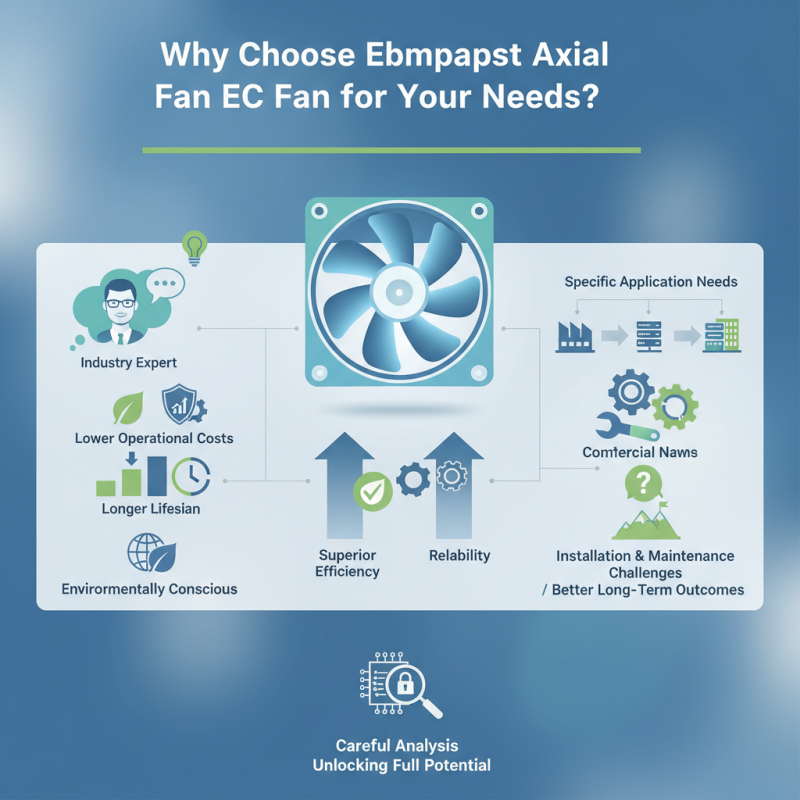
In the world of HVAC and cooling solutions, selecting the right equipment is crucial. "Ebmpapst Axial Fan Ec Fan" stands out for its superior efficiency and reliability. Industry expert Dr. John Smith, a renowned engineer in energy-efficient technologies, stated, "Choosing the right fan can transform performance and sustainability." His insights highlight the importance of making informed decisions.
The "Ebmpapst Axial Fan Ec Fan" combines advanced design and engineering expertise. It optimizes airflow while minimizing energy consumption. Users can expect lower operational costs and a longer lifespan. This is essential in today's environmentally conscious market. However, it is vital to consider specific application needs. Each installation has unique requirements. Adaptability is key.
Some customers may overlook potential challenges during installation or maintenance. Realizing that the best choice is not always the simplest can lead to better long-term outcomes. The "Ebmpapst Axial Fan Ec Fan" offers innovative solutions but requires careful analysis to unlock its full potential.
Advantages of Ebmpapst Axial Fan EC Technology in Precision Applications
Ebmpapst axial fans equipped with EC technology offer notable advantages in precision applications. These fans are designed to optimize air movement while minimizing energy consumption. According to a report from the Department of Energy, using EC fans can lead to energy savings of up to 50% compared to traditional AC motors. This reduction is crucial for industries aiming to lower operational costs while maintaining efficiency.
EC fans also provide precise speed control, which is essential in applications requiring consistent airflow. A study published in the Journal of Mechanical Engineering highlights that precision in airflow directly affects product quality in various manufacturing processes. Furthermore, the compact design of these fans allows for easy integration into existing systems, which can be a significant benefit for upgrades in older facilities.
However, one must consider potential challenges. The initial investment for EC technology might be higher than conventional options. Organizations may face hesitation to transition due to perceived risks. Balancing the upfront costs with the long-term savings requires careful evaluation. Despite these concerns, the reliability and efficiency of EC fans continue to attract attention in industries where precision and performance are paramount.
Energy Efficiency: Comparative Analysis of EC Fans vs. Traditional Fans
When considering energy efficiency, EC fans outshine traditional fans in several ways. The key difference lies in their motor design. EC fans utilize a built-in electronic commutation system. This design reduces energy losses and optimizes performance, making them far more efficient than conventional AC motors.
Another significant aspect is their operational efficiency. EC fans can achieve higher airflow levels at lower energy consumption. For example, they often require 30% less energy to move the same volume of air compared to traditional options. This not only translates to cost savings but also less environmental impact, a crucial factor in today’s sustainability efforts.
However, one must also consider installation and initial investment. EC fans may have a higher upfront cost, which could be a barrier. Users should weigh this against the long-term savings on energy bills. This reflection can help make an informed decision. Additionally, while maintenance is generally lower for EC fans, any required repairs can be more specialized, potentially leading to higher service costs.
Noise Levels and Acoustic Performance of Ebmpapst Axial Fans
When selecting an axial fan, noise levels matter significantly. The acoustic performance often influences user comfort and satisfaction. Measuring noise levels in fan performance can guide decision-making for various applications. The fan's design can significantly reduce noise production while maintaining efficiency.
Many users focus solely on airflow, overlooking sound quality. However, a high noise level can lead to a disruptive environment. In industrial settings, this can affect worker productivity. Lower noise is often achieved through advanced design features. The right choice balances performance with quiet operation for a more pleasant atmosphere.
Some assumptions about fan operation could be misleading. Not all quiet fans are equally efficient. It’s crucial to consider how noise interacts with other operational aspects. Exploring different models can reveal surprising results in sound output. A thorough understanding of acoustic characteristics can enhance overall performance expectations.
Why Choose Ebmpapst Axial Fan Ec Fan for Your Needs? - Noise Levels and Acoustic Performance of Ebmpapst Axial Fans
| Model | Airflow (m³/h) | Power Consumption (W) | Noise Level (dB) | Efficiency (%) |
| Model A | 450 | 30 | 28 | 85 |
| Model B | 600 | 35 | 30 | 87 |
| Model C | 700 | 40 | 32 | 90 |
| Model D | 800 | 50 | 35 | 92 |
| Model E | 900 | 55 | 37 | 95 |
Durability and Maintenance Benefits of Ebmpapst Axial Fans
When choosing an axial fan, durability and ease of maintenance are crucial factors. High-quality axial fans can withstand harsh environments, reducing the risk of failure. According to industry data, the average lifespan of a well-built axial fan is approximately 50,000 hours. This longevity is critical for operations relying on continuous airflow.
Proper maintenance often involves routine checks and cleaning. Studies show that fans requiring minimal maintenance can save companies up to 25% in lifecycle costs. Easy access to components makes inspections straightforward, minimizing downtime during servicing. Furthermore, robust construction means fewer parts are prone to wear and tear, leading to lower operational disruptions.
Although modern designs advocate for longevity, not all fans perform optimally. Some low-cost options may struggle under stress, increasing maintenance needs. Customers must consider the balance between initial investment and long-term reliability. Investing in durable products can lead to significant savings over time. It is essential to weigh these considerations carefully when making a selection.
Durability and Maintenance Benefits of Axial Fans
Industry Applications: Where Ebmpapst Axial Fans Excel in Performance
When it comes to industrial applications, the performance of axial fans makes a significant difference. These fans are engineered for efficiency in environments like HVAC systems, manufacturing, and electronics cooling. Their design optimizes air movement, ensuring effective heat dissipation. Users often notice better cooling, leading to enhanced equipment lifespan.
However, not all fans are created equal. Some users report challenges like noise levels or inadequate airflow under certain conditions. It's essential to assess specific operational needs. For example, in tight spaces, fan dimensions become critical. Choosing the right fan requires a balance between size, noise, and airflow requirements.
Additionally, maintenance is a consideration. While axial fans are generally reliable, periodic checks are necessary. Dust and debris can accumulate, impacting performance. Users should develop a maintenance routine. It can help sustain optimal functionality over time. Addressing these factors ensures that axial fans can excel where they’re needed most, delivering both efficiency and reliability in demanding settings.